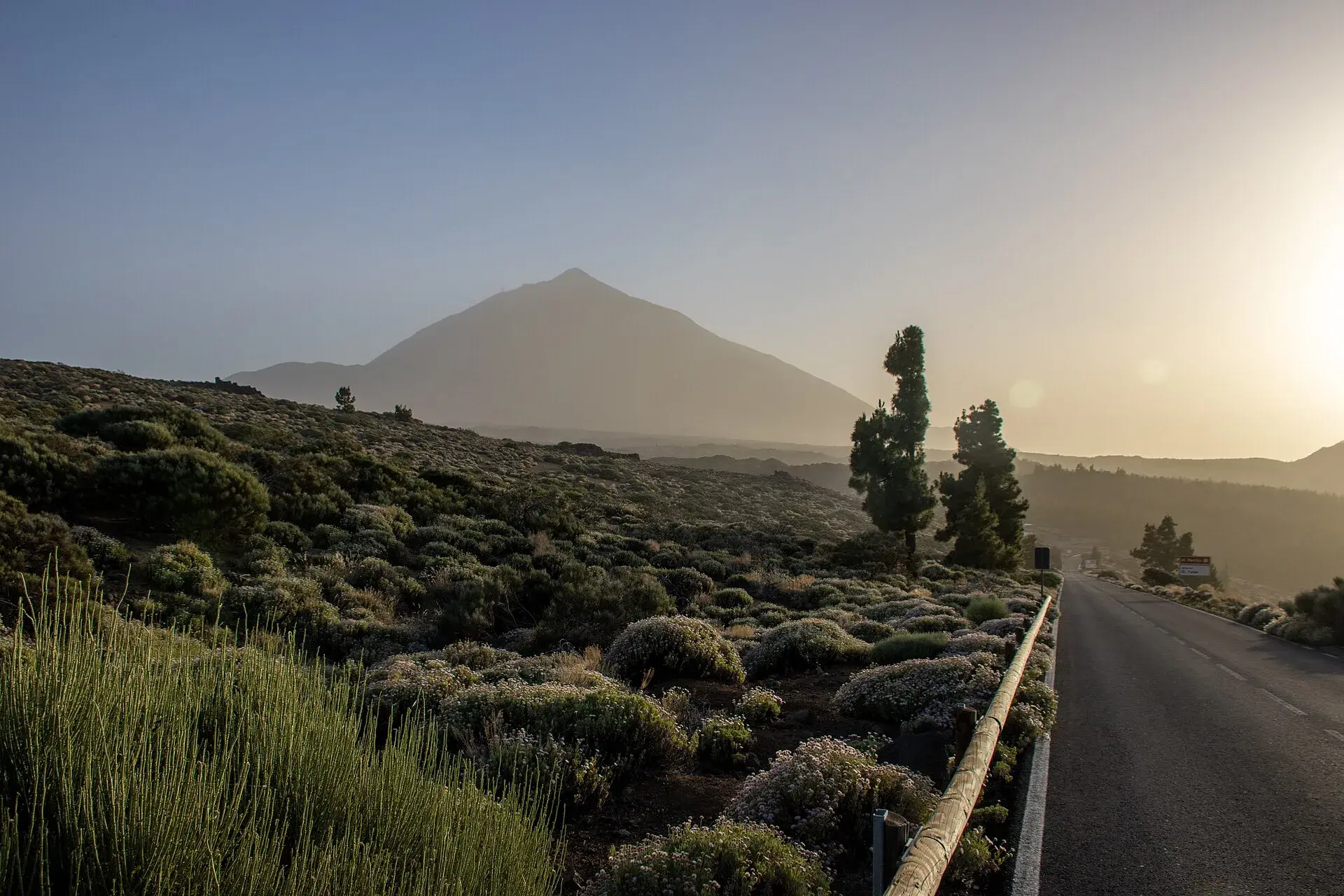
Photo by Photograph by Mike Peel ( www.mikepeel.net )., CC BY-SA 4.0, via Wikimedia Commons
Calima in Tenerife: what it is, when it comes, how it affects you
Calima in Tenerife is dust from the Sahara desert that easterly or south-easterly winds carry in suspension to the Canary Islands. The sky turns whitish or orange, visibility drops, air quality worsens and the temperature often rises. An episode usually lasts one to three days and can come at any time of year. It is not dangerous for most visitors, but it is unpleasant for anyone with asthma, allergies or heart problems. If it coincides with your trip, simply change that day's plan: less exertion outdoors and more indoor activities.
What exactly calima is
Sandstorms in the Sahara lift fine particles that the wind carries hundreds of kilometres over the Atlantic. The Canary Islands, about a hundred kilometres from the African coast at their closest point, lie in their path. When the wind blows from the east, instead of the humid north-east trade winds, that dust settles over the islands. It is not fog or local pollution: it is mineral particles, measured as PM10 and PM2.5 at air quality stations. Intense episodes have recorded extremely high concentrations: in February 2021, AEMET (the Spanish State Meteorological Agency) measured more than 700 micrograms of PM10 per cubic metre at its Santa Cruz observatory, when the daily health limit is 50.
When calima usually happens
There is no fixed season, but there is a pattern. Studies by AEMET's Izaña Atmospheric Research Centre, on Mount Teide, distinguish two types of episode:
- Winter and spring: the dust arrives in a low layer, confined to the first two kilometres of altitude. This is the calima you notice most on the coast and in towns, the one that turns the sky grey over Santa Cruz or Costa Adeje and causes the most dramatic episodes, such as the one in February 2020.
- Summer: the dust travels higher, in the so-called Saharan air layer, which can extend up to about six kilometres. It often comes with heatwaves and above-normal temperatures in the midlands and on the coast.
In practice, a traveller can encounter calima in any month. Winter episodes affect visibility and flights the most; summer ones push the thermometer up the most. AEMET issues warnings one or two days in advance, so there is no point ruling out dates for fear of calima: the general weather by month is in Tenerife weather by month.
How calima affects you
Visibility
The landscape blurs: La Gomera can no longer be seen from the coast, Mount Teide appears as a silhouette or disappears, and photos come out flat. Viewpoints lose their point, so it is not a day for the drive across the summits or for the guide to viewpoints.
Air quality and health
Suspended dust irritates the eyes, throat and airways. Most healthy people only notice dryness or a slight cough, but sensitive groups can have real problems. The health authorities warn that symptoms can appear in the days after the episode, not only during it.
Temperature
With easterly wind and dust, the temperature usually rises several degrees, especially in summer, and humidity drops.
Flights
Calima reduces visibility on runways and can force flights to be diverted or cancelled. The most serious recent case was the weekend of 22 and 23 February 2020: dust and strong winds left Gran Canaria and Tenerife North airports unable to receive flights from outside the islands, and Aena (the Spanish airport operator) counted hundreds of cancellations and diversions across the archipelago. That is exceptional: the usual outcome is an occasional delay or diversion. If you are flying on a day with a dust warning, check your flight status with the airline before setting off for the airport; the differences between the two airports are in Tenerife airports.
Official health advice
For every significant episode, the Directorate General of Public Health of the Government of the Canary Islands repeats the same advice:
- Avoid physical exertion outdoors, including sport and long walks.
- Stay indoors as much as possible, with doors and windows closed.
- Stay hydrated and in humid environments.
- Clean dust off surfaces with damp cloths, not dry ones.
- Continue taking your usual medication.
- If respiratory symptoms get worse, call 112.
The advice is aimed especially at children, older people, pregnant women, people with chronic respiratory or heart conditions (asthma, COPD, heart failure), smokers and those who work outdoors. If you are travelling with someone in one of these groups, keep their reliever medication to hand and plan the day close to your accommodation. An FFP2 mask helps sensitive people outdoors.
Where to check warnings
- AEMET: warnings for suspended dust and for temperatures appear on its website and app, by area of Tenerife (north, south, metropolitan area, summits).
- Government of the Canary Islands: it declares a calima pre-alert or alert when particulate matter exceeds the health protection thresholds, and 112 Canarias spreads it on its social media.
- Air quality index: the Canary Islands Air Quality Monitoring Network publishes the index for each measuring station on the island in real time.
If your accommodation is in a particular area, look at the nearest station: some episodes affect the south and east side more than the north, and vice versa.
What to do on a calima day
Calima covers the whole island, so switching sides rarely helps. What works is reversing the plan: indoors first, outdoors short and gentle.
- Museums and towns: the MUNA and the TEA in Santa Cruz, the Museum of Science and the Cosmos in La Laguna or the old town of La Orotava let you spend the morning under cover. The route is in the Santa Cruz de Tenerife guide.
- Spas and indoor pools: thalassotherapy centres and hotel spas are the plan most in line with the health authorities' advice.
- Shopping and indoor spaces: shopping centres, museums and the Auditorio let you spend the dustiest hours indoors.
- A long lunch: a calima day is a good moment for a guachinche or a winery with an indoor visit.
Full ideas by area, with opening hours, are in what to do in Tenerife when it rains: they work just as well for calima. What to postpone: hiking, mountain biking, going up Mount Teide for the views and long boat trips if it is also windy.
Myths about calima
"Calima only comes in summer"
No. Winter episodes are frequent and affect visibility the most; the February 2020 episode closed airports, and another intense one, in February 2021, lasted several days.
"It is smoke or pollution from the island"
No: it is mineral dust from the desert. What can happen is that, in summer, calima coincides with heat and forest fire risk, which the Cabildo (the island government) manages with its own alerts.
"Going up Mount Teide gets you above the calima"
Sometimes, in winter episodes, the dust stays below about two kilometres and Las Cañadas sits above it, but the views towards the coast are lost all the same. In summer the dust layer rises much higher and also covers the summit. It is not worth planning the ascent on a calima day.
"You cannot go to the beach during calima"
You can, but it is not the best day: the sun loses strength under the dust and the air feels heavier. Swimming carries no added risk; running along the promenade does, for sensitive people.
Frequently asked questions
How long does a calima episode last in Tenerife?
Usually one to three days, although there are episodes of almost a week with successive waves of dust. AEMET's warnings indicate when it is expected to ease.
Is calima dangerous for tourists?
For a healthy person, no: at most, dry eyes or a slight cough. For small children, older people, pregnant women and people with asthma or heart conditions, it is worth following the health authorities' advice and limiting time outdoors.
Are flights cancelled because of calima?
Rarely. Total closures, like the one in February 2020, are exceptional. On a day of dense calima the norm is occasional delays or diversions; check with the airline before going to the airport.
Does calima bring mud rain?
It happens when a calima episode coincides with rain: the drops wash the dust down and leave cars and terraces stained. It is not frequent, because calima usually comes with dry weather.
Keep planning
You may also like
Accessible Tenerife: beaches, transport and step-free visits
Accessible Tenerife: beaches with assisted bathing and amphibious chairs, airport assistance, buses, tram and eurotaxi, and which visits work in a wheelchair.
Car hire in Tenerife: insurance, deposit and useful tips
Car hire in Tenerife without surprises: when it pays off, insurance and excess, deposit, fuel, child seats, Masca, Teide and what to check at pick-up.
Digital nomads in Tenerife: visa, areas, housing and internet
Digital nomads in Tenerife: the remote work visa and 2026 requirements, EU citizen registration, the best areas to live, renting, healthcare and internet.
Tipping in Tenerife, money and IGIC: what you need to know
Tipping in Tenerife, paying by card, cash machines, IGIC versus VAT, tax refunds for travellers and tobacco and alcohol allowances when you fly home.