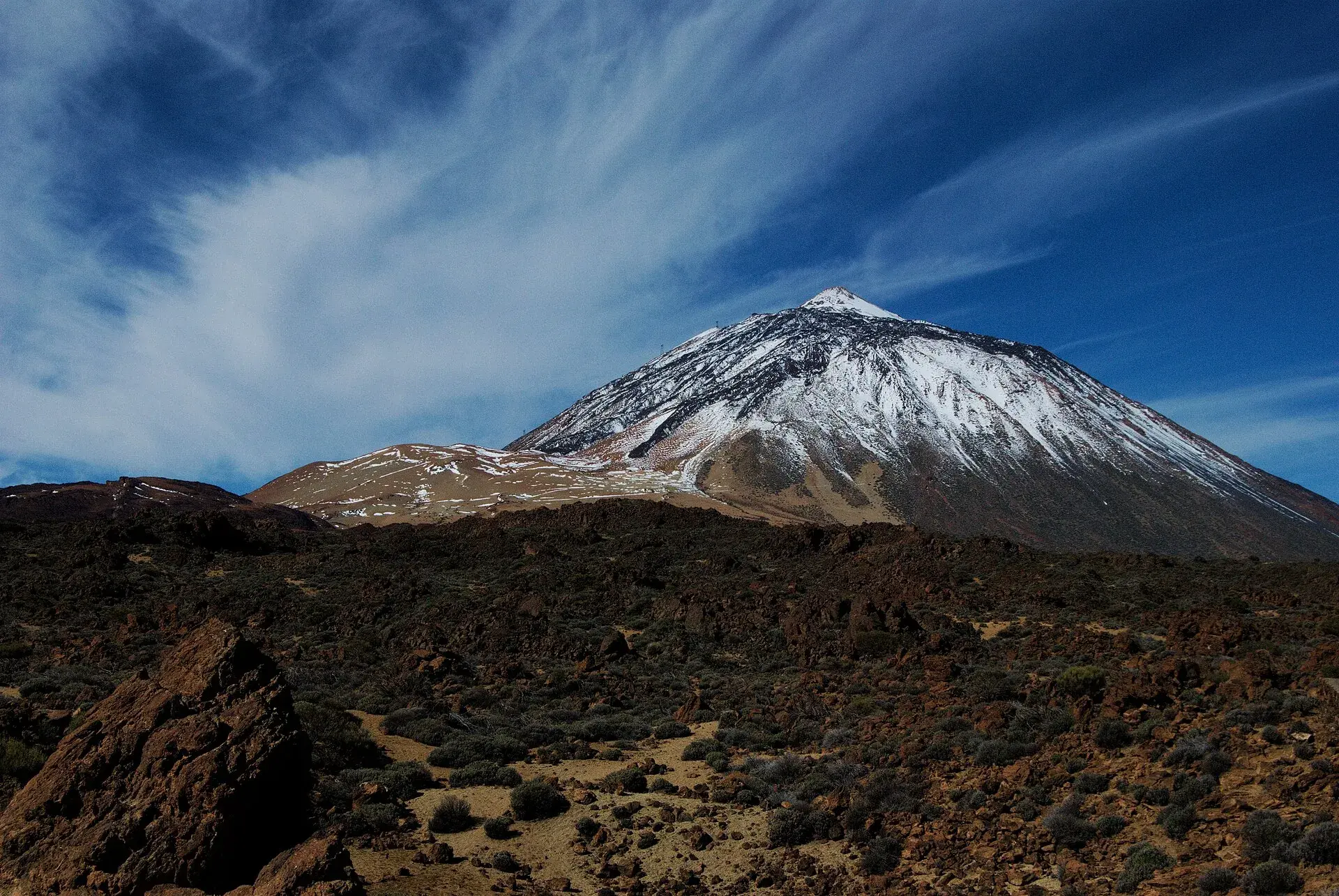
Photo by PabloFGarrido, CC BY-SA 4.0, via Wikimedia Commons
Snow on Teide in Winter 2026-2027: When It Snows and How to Go
Seeing Teide covered in snow is possible almost every winter, but not on a specific date: snow arrives in spells of two or three days, mostly between December and March, and every heavy snowfall brings road closures because of ice. The pattern repeats: the Cabildo (island government) closes the access roads while there is ice, reopens them once they have been cleared and, if it expects a flood of visitors, restricts private cars and lays on guaguas (buses) as shuttles. What changes with each storm are the dates, the roads and the timetables, which are announced only one or two days in advance.
When it usually snows on Teide
AEMET's observatory at Izaña, at about 2,370 m next to the national park, records in its climate normals (1981-2010) an average of about 2.4 days of snow in January, 2.5 in February, 2.1 in March and 1.6 in December. In November and April it drops below one, and from May to October it is exceptional. On the summit, at 3,718 m, the snow usually lasts longer than in the caldera.
The averages hide a lot of variation: in the 2022-2023 season Izaña received less than half its usual snow, in only three spells. Recent episodes show the typical pattern:
- 22 December 2024: the Cabildo closed the TF-21, the TF-24 and the TF-38 because of snow and patches of ice.
- Mid-December 2025: a snowfall turned the park white just before Christmas; the access roads reopened on 16 December at midday, only for cars and on specific routes, and the following weekend the shuttle scheme explained below was activated.
- 26 February 2026: about 3 cm of snow and ice forced the closure of the TF-21 between La Caldera and the cable car, the Boca Tauce entrance and the TF-24 from the Los Loros junction. They reopened that same afternoon.
- 3 to 5 March 2026: storm Regina brought snow to Teide and closures of the TF-21 and the TF-24; the Cabildo closed them again as a precaution on the afternoon of the 4th because ice was forecast.
At Christmas snow is possible but not guaranteed (see the Christmas in Tenerife guide); January, February and the first half of March give you better chances. The climate of each month on the coast and at the summit is in Tenerife weather by month.
How to check for snow before going up
The peak can look white from the coast while the roads are closed. Before you set off, check:
- AEMET warnings for the Tenerife summits: they announce snow, snow level and wind one or two days ahead.
- Cabildo road status: the Road Information Centre and the Cabildo's official profiles publish every closure and reopening. It is the only valid source for knowing whether you can drive up.
- Cable car webcams: its official website has three live cameras (the peak, the Ucanca valley and the park) and an indicator of the status of the service and of the trails at the top.
- Cabildo announcements about restrictions and shuttles, which regional media report the same day.
Look at them the evening before and in the morning.
Road closures due to ice and snow
With snow or patches of ice, the Cabildo closes the access roads to the park to private traffic and does not reopen them until the machines have cleared the road. The closure usually affects:
- TF-21 from La Orotava, at Aguamansa or La Caldera. It is the first to close.
- TF-24 from La Esperanza, at the Los Loros junction.
- TF-38 from Chío and the TF-21 via Boca Tauce, in the heaviest snowfalls.
- The stretch of the TF-21 inside the park between El Portillo and the cable car.
Reopening is usually staggered: in December 2025 the southern access via Vilaflor and the stretch from Aguamansa to El Portillo opened first, only for cars, with the TF-24 still closed towards Teide. Check which access is open and plan your route accordingly. The Teide National Park guide describes the four accesses and what you will find on each.
Shuttle buses and restricted access: the December 2025 case
When snow coincides with a weekend and the roads are already clear, the problem becomes the crowds. The most recent precedent of limiting private cars and using TITSA buses is that of 20 and 21 December 2025:
- Restriction: from 18:00 on Friday 19 until 10:00 on Monday 22 you could not drive up in a private car. It was not a total closure but controlled access.
- Free shuttles from three points: Vilaflor to the cable car, La Esperanza (calle La Sardinera) to the Izaña junction and Aguamansa to El Portillo Alto.
- Timetable: trips up from 10:00 to 14:00 and last trips down from the park at 17:00.
- Other measures: a 50 km/h speed limit and closure of trails and recreational areas depending on their condition.
According to the Cabildo, 5,536 people used the shuttles and at least 1,845 cars did not enter. If it happens again, the conditions will be announced only a few days ahead and may be different.
This season there is also a deeper change under way. The Cabildo has taken over the management of the park and has announced access control at the La Esperanza, La Orotava and Vilaflor-Chío entrances at the end of 2026, and a shuttle network for 2027 with a ticket of about €7 for visitors. As of October 2026 there is no confirmed start date: if you are travelling this winter, check on the Cabildo website whether the system is already in operation.
Rules in the snow: what you cannot do
On snow days there are more environmental officers and Guardia Civil in the park. Bear in mind:
- Do not leave the trails or the roads. The park's management plan prohibits walking off the signposted trails. Climbing the slopes to sledge or to walk on fresh snow means leaving them, as well as damaging endemic plants that lie under the snow.
- Park only in designated areas. A car on the hard shoulder gets in the way of snowploughs and emergency vehicles, and parking off-road in a protected area is fined.
- Closed trails. With ice, the Cabildo closes trails, including those at the upper cable car station and Montaña Blanca. A closed trail must not be walked even if it looks passable.
- No smoking. Since 19 June 2026 smoking has been banned throughout the park, including car parks and viewpoints.
- No drones. Recreational drone flying is prohibited in the park. The other rules are gathered in rules for Tenerife's natural areas.
What to bring if you go up in the snow
- Proper winter clothing: at Izaña the average January minimum is around 1 °C and there are about 12 days of frost a month. Hat, gloves, waterproof jacket and layers.
- Shoes with mountain soles, never smooth trainers: ice in car parks and at viewpoints causes more falls than the snow itself.
- Sunglasses and sun cream: snow reflects the radiation and at that altitude you burn quickly.
- A full tank, water and food: with closures and queues, the journey takes longer.
- Snow chains: car hire companies in Tenerife do not include them and their contracts exclude driving on closed roads. If you hire a car, check the conditions in car hire in Tenerife.
The cable car in the snow
In snow, the cable car usually runs if there is no strong wind, which is common in winter storms. The company announces suspensions first thing in the morning and refunds or exchanges the ticket. Even if it runs, the trails at La Rambleta may be closed because of ice, and in that case the ticket remains valid but is not refunded. Details of closures and refunds are in the Teide cable car guide.
The summit in the snow is another matter. The summit permit is not enough: with ice the Telesforo Bravo trail requires crampons and an ice axe, and when reopening after the latest snowfalls the Cabildo has only allowed equipped mountaineers to climb, with authorisation on Tenerife ON. Do not attempt it without winter experience.
Where to take the best photos of snowy Teide
- Mirador de Humboldt (La Orotava): the green valley with the white peak in the background, without driving up; the easiest photo on closure days.
- Chipeque and La Tarta (TF-24): Teide above the mar de nubes (sea of clouds) and the pine forest. They depend on the TF-24 being open.
- Roques de García and Llano de Ucanca: the snowy cone behind the Roque Cinchado, the park's classic image.
- Boca Tauce: the first full view of Teide and Pico Viejo if you come in from the south.
Early in the morning there is better light, fewer people and less wind. Details of each in the best viewpoints in Tenerife.
Safety: cold, ice and altitude
- Hypothermia: wind, wet clothes and hours standing still are the dangerous combination, especially with children. If someone is shivering non-stop or seems clumsy, go back to the car and drive down.
- Ice: early in the morning and in the shade you cannot see it. Walk slowly and avoid slopes.
- Daylight: in winter it gets dark early and the temperature plummets. Come down while it is still light.
What is usual and what depends on each storm
- Repeats every winter: snowfalls from December to March, closure of the TF-21 and the TF-24 when there is ice, reopening after clearing, huge crowds on the following days and closed trails.
- Depends on each episode: dates, closed roads, shuttles and their timetables, and whether the new access control is already in operation.
Frequently asked questions
When does it snow on Teide?
Mostly between December and March, with January and February the months with the most snow days at Izaña according to AEMET. These are short spells, with no guarantee for any particular week.
Can you drive up Teide when there is snow?
Only when the Cabildo reopens the roads, sometimes only some of the accesses. If there is a restriction because of crowds, you go up on the shuttles that are announced.
How do I know if the Teide roads are closed?
From the Cabildo's Road Information Centre and its official profiles, which publish every closure and reopening. AEMET's warnings for the summits give advance notice.
Will there be shuttle buses to Teide in winter 2026-2027?
There is no scheme announced in advance: the Cabildo activates it when it considers it necessary after a snowfall, as it did in December 2025. It has also announced access control and a shuttle network for 2027, with no confirmed start date as of October 2026.
Can you play in the snow or go sledging on Teide?
You can enjoy the snow at viewpoints and open areas, but you cannot leave the signposted trails, which is what sliding down the slopes involves.
Keep planning
You may also like
What's on in Tenerife in November 2026
23 events in Tenerife in November 2026 with date, time and venue: concerts, theatre, local fiestas, sport and more. The agenda is updated every week.
Things to do in Tenerife this weekend (23–25 October)
12 plans for this coming weekend in Tenerife with date, time and venue: concerts, theatre, local fiestas and more. The agenda is updated every week.
Candelaria Festival 2027: 2 February in Tenerife
The Candelaria festival on 2 February 2027: the candle procession, Mass and procession of the Patroness, usual times, buses and what to see in Candelaria.
Easter in Tenerife 2027: Processions, Adeje and Holidays
Holy Week in Tenerife 2027, 21 to 28 March: La Laguna's Madrugada, the Passion of Adeje, Garachico, La Orotava, public holidays, buses and March weather.