Photo by Photograph by Mike Peel ( www.mikepeel.net )., CC BY-SA 4.0, via Wikimedia Commons
Museums and culture in Tenerife: a practical guide by area
Culture in Tenerife is concentrated in a small triangle: Santa Cruz and La Laguna hold the main museums, the contemporary art centre and the theatres, and are linked by tram; La Orotava and Garachico preserve the colonial heritage of the north; and the festival calendar, from the summer romerías to Carnival in February, covers what does not fit in a display case. This guide sorts the museums by area, with opening hours and prices taken from the official websites, and explains how to fit each visit into a day of your trip.
What to know before you start
The Cabildo's public museum network, Museos de Tenerife, brings together three museums (MUNA, Science and Cosmos, and History and Anthropology, the last with several sites) under shared rules. According to its official website:
- General admission: €5 for the permanent exhibition; €3 for Canary Islands residents. The reduced ticket (students, pensioners, over-65s, large families and groups of more than 8 people) costs €3.50, or €2 for residents.
- Free: children under 8, and everyone on Fridays and Saturdays from 16:00 until closing. If the Friday or Saturday is a public holiday, free entry starts at 14:00. At Casa de Carta it always starts at 14:00.
- Closed: 24, 25 and 31 December, 1 and 6 January and Carnival Tuesday.
- Combined pass: the official website does not publish any combined ticket for several museums; if you are interested, ask at the ticket office.
In practice, if your trip includes a Friday or a Saturday, save the museum that interests you most for that afternoon and visit it for free.
Santa Cruz de Tenerife: museums within walking distance of the centre
MUNA, Museum of Nature and Archaeology
It is the best visit for understanding who the Guanches were, the people of Tenerife before the Castilian conquest. The archaeology section, with its mummies, is the main reason to go; the natural sciences section explains the volcanic origin of the archipelago and its fauna and flora.
- Area: central Santa Cruz, near Plaza de España · Opening hours: Monday to Saturday 9:00–19:00; Sundays and public holidays 10:00–17:00 · Admission: €5 general, €3 for Canary Islands residents · Time needed: at least two hours · Best for: a first introduction to the island's history
TEA Tenerife Espacio de las Artes
The Herzog & de Meuron building on Avenida de San Sebastián houses exhibition rooms with work by Óscar Domínguez and by Canarian and international artists, the Centro de Fotografía de la Isla de Tenerife and a library. Exhibitions and guided tours are free; only the cinema charges admission.
- Opening hours: check the current hours on the TEA website before you go · Admission: free to the exhibitions · Time needed: one to two hours · Best for: contemporary art and architecture
Castillo de San Cristóbal
Beneath Plaza de España lie the remains of the city's old defensive castle, now an interpretation centre run by the Museum of History and Anthropology. It opens Monday to Saturday 10:00–18:00 and does not take long to see, so it fits between MUNA and a walk around the centre.
The Auditorio and the Teatro Guimerá
The Auditorio de Tenerife Adán Martín, Santiago Calatrava's white building by the sea, is home to the Orquesta Sinfónica de Tenerife and to the opera, dance and music season. The Teatro Guimerá, right in the centre, is the capital's historic theatre and stages drama, dance and music all year round. Programmes and tickets for both are on their official websites.
San Cristóbal de La Laguna: the World Heritage city
La Laguna was the island's first capital and its historic centre has been on the UNESCO World Heritage List since 1999. Its grid layout, without city walls, served as a model for many cities founded later in the Americas. From Santa Cruz you get there on tram line 1 in a few minutes, with no parking worries; transport options are in the guide to getting around Tenerife.
Museum of History and Anthropology: Casa Lercaro
It occupies a 17th-century mansion on Calle San Agustín and tells the island's history from the conquest onwards: economy, society, daily life. The building, with its courtyard and wooden balconies, is part of the visit. Same opening hours as MUNA and general rate.
Museum of Science and the Cosmos
It is on the edge of the old town, on Avenida de Los Menceyes. It is a hands-on museum of experiments covering the universe, the human body and physics, with a planetarium where sessions cost €1. It is the most rewarding cultural visit if you are travelling with children; you will find more ideas in Tenerife with kids.
Casa de Carta
The second site of the Museum of History and Anthropology is in Valle de Guerra, within the municipality of La Laguna but far from the old town. It is a traditional house devoted to rural ethnography. It opens every day 10:00–17:00 and you need a car or a guagua (the local word for bus) to get there.
The old town and the Teatro Leal
La Laguna is best explored on foot: the cathedral, the Iglesia de la Concepción with its tower, the mansions on Calle San Agustín and the municipal market on Plaza del Cristo. The Teatro Leal, from the early 20th century, stages drama, music and dance; its listings are published on the town hall website and in the island's events calendar.
The north: La Orotava, Garachico and Güímar
La Orotava and Garachico are the other great block of heritage: manor houses with wooden balconies, baroque churches and cobbled streets. We describe them in detail in the prettiest villages in Tenerife, so here we cover only the cultural side:
- La Orotava: its historic quarter can be seen on foot in a morning. It is also the capital of calado (embroidery on drawn-thread fabric) and of the Corpus carpets (see below).
- Garachico: the town rebuilt after the 1706 eruption, with the Castillo de San Miguel, the former Franciscan convent and Plaza de la Libertad.
- Pirámides de Güímar: in the east, next to the TF-1 motorway. It is a park with six astronomically aligned stepped pyramids, a museum, a botanical garden and trails. It opens every day 10:00–18:00 except 1 January and 25 December. Prices vary by ticket type: check the official website. Almost everything is outdoors, so bring sun protection.
Living traditions: romerías, magos, flower carpets and Canarian wrestling
Romerías and bailes de magos
Between spring and the end of summer, many municipalities hold their romería (a festive pilgrimage): decorated carts, often pulled by oxen, groups singing and playing music, and people in traditional dress ("magos" is the Canarian word for country people). Food and wine are handed out from the carts. The baile de magos is the open-air dance that follows, with a band and folk music. These are popular, free festivals.
Dates change every year: check the site's events calendar and the municipal websites.
The Corpus carpets in La Orotava
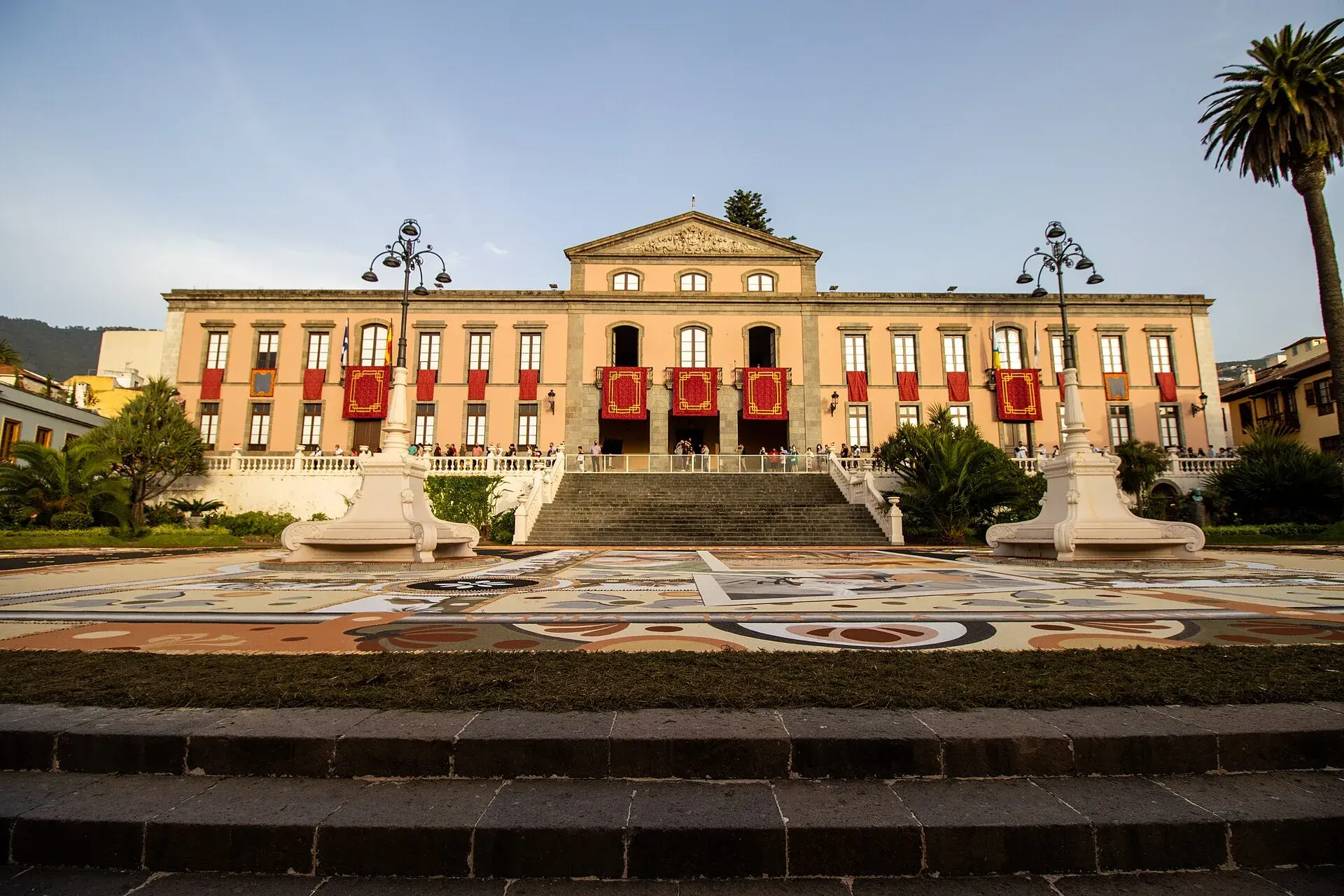
It is the most striking tradition on the island. During the Corpus festivities, the streets of central La Orotava are covered with carpets made of flowers and other plant materials, and in Plaza del Ayuntamiento a huge tapestry is composed with volcanic sands from the Parque Nacional del Teide. The Government of the Canary Islands declared them a Site of Cultural Interest (Bien de Interés Cultural) in 2007. In 2026 the festivities ran from 15 May to 14 June, closing with the San Isidro romería. Dates vary each year with the liturgical calendar.
Lucha canaria
Canarian wrestling is the islands' native sport: two wrestlers grip each other in a terrero (a sand circle) and the winner is whoever makes the opponent touch the ground with any part of the body other than the feet. There are terreros in many municipalities and bouts are announced in the local press.
A note on silbo
Silbo, the whistled language recognised by UNESCO, belongs to La Gomera, not Tenerife. If it interests you, the neighbouring island is a short ferry ride from Los Cristianos and can be visited as a day trip.
Crafts: what to look for and where to buy
The two most characteristic crafts are calado, embroidery on drawn-thread fabric used for tablecloths, handkerchiefs and household linen, and traditional pottery, shaped by hand without a wheel using techniques inherited from pre-Hispanic pottery. To buy with confidence:
- Artenerife, the Cabildo's island crafts company, sells work by island artisans in its shops.
- Craft fairs run by the municipalities and the island, especially around Christmas and Epiphany and during patron saint festivities.
- Price as a clue: a hand-made calado tablecloth takes many hours of work. If it is very cheap, it is probably not local craftwork; ask about its origin and look for the craft label.
The Santa Cruz Carnival
The Santa Cruz Carnival, in February or early March, is the main cultural event of the year, with murga and comparsa contests, the election of the queen and several days of street parties. The dates of each edition are in the events calendar. The Cabildo museums close on Carnival Tuesday.
How to combine visits
- A day in Santa Cruz: MUNA and the Castillo de San Cristóbal in the morning, TEA in the afternoon and the Auditorio at dusk. All on foot, and TEA is closed on Mondays.
- A day in La Laguna: the old town and Casa Lercaro in the morning, lunch in the centre and the Museum of Science and the Cosmos in the afternoon. On a Friday or Saturday, save the museum that interests you most for after 16:00 and you will get in free.
- Half a day in the north: La Orotava in the morning, taking your time over the old town, and Garachico in the afternoon.
- With the south as your base: the Pirámides de Güímar are on the way to Santa Cruz along the TF-1, so they combine well with a day in the capital.
- A rainy day: museums are the natural choice; indoor plans are in what to do in Tenerife when it rains.
Frequently asked questions
What is the best museum in Tenerife?
To understand the island, MUNA in Santa Cruz, for its archaeological collection on the Guanches. If you are travelling with children, the Museum of Science and the Cosmos in La Laguna. For contemporary art, TEA, which is also free.
Which days are Tenerife museums free?
The Cabildo museums (MUNA, Science and Cosmos, History and Anthropology) are free on Fridays and Saturdays from 16:00 until closing, and from 14:00 at Casa de Carta or on public holidays. TEA's exhibitions are always free.
How much time do you need for La Laguna?
Half a day is enough for the old town and one museum. If you want to see Casa Lercaro and the Museum of Science and the Cosmos, allow a full day.
When can you see the La Orotava carpets?
During the Corpus festivities, between late May and June depending on the year, or in early July when Corpus falls late. The carpets are ephemeral: they are laid out and walked over within a few days, so check the exact dates before planning your trip.
Keep planning
You may also like
Loro Parque guide: opening hours, shows and getting there
Visiting Loro Parque in Puerto de la Cruz: show times, Planet Penguin, the free train, parking, the Twin Ticket, food and practical tips for a full day out.
Siam Park guide: rides, height limits and getting there
Visiting Siam Park in Costa Adeje: rides and height limits, opening hours, free buses, Fast Pass, lockers, food and practical tips for Tenerife's water park.
Barranco del Infierno hike: tickets, booking, times and rules
Barranco del Infierno hike in Adeje: tickets at €16, €6 for Canary residents, compulsory booking, entry times, minimum age, helmet, rain closures and buses.
Free things to do in Tenerife: beaches, pools, hikes, museums
Free things to do in Tenerife: beaches, rock pools, viewpoints, permit-free hikes, old towns, free museums and fiestas, and what costs parking or a booking.