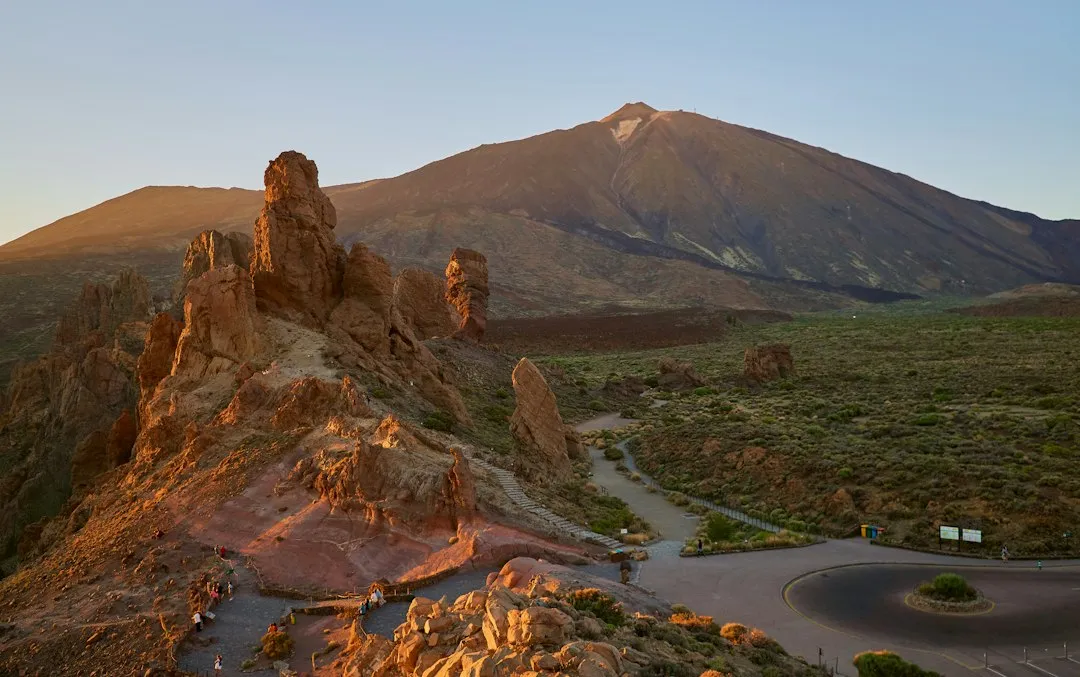
Photo by Joshua Humpfer on Unsplash
Top Things to Do in Tenerife: The Essential List
Volcano and night sky
Mount Teide. At 3,718 m the Teide is the highest peak in Spain and the island's one unmissable landscape. The cable car climbs from 2,356 m to La Rambleta at 3,555 m in under eight minutes; book a time slot online in advance, as it sells out in high season and stops in strong wind. The last stretch to the crater on the Telesforo Bravo trail needs a separate national park permit from the Tenerife ON platform, and since January 2026 non-residents pay a fee of the order of 10–15 € per person depending on the option; places go quickly. Without a car, TITSA lines 342 (from Costa Adeje) and 348 (from Puerto de la Cruz) make one return trip a day.
Stargazing in the park. Teide National Park is a certified Starlight destination, sits above the clouds and hosts the Izaña observatory. The Minas de San José viewpoint on the TF-21 is the usual spot. Go close to the new moon and dress for winter even in August.
Forests, gorges and old towns
Anaga and Taganana. The north-eastern tip of the island is a Biosphere Reserve of knife-edge ridges covered in laurel forest. Start at the Cruz del Carmen visitor centre, walk one of the short circular trails, then drive down to Taganana and the black-sand coast at Almáciga for grilled fish. TITSA line 946 reaches Taganana from Santa Cruz.
Masca. The hamlet of Masca hangs in the Teno massif at the end of the TF-436, a road of hairpins and single-lane stretches; the viewpoints above the village are what most visitors come for. Walking the gorge down to the sea is a different undertaking: access is limited to a daily quota, must be booked in advance on the official site, and uses an authorised shuttle to the trailhead and a boat out. Count on the whole day.
La Laguna. San Cristóbal de La Laguna, the island's first capital, has been a World Heritage Site since 1999 as the first unfortified Spanish colonial town. Walk the pedestrian streets around Calle Obispo Rey Redondo and the mansions with wooden balconies and patios. Tram line 1 links it to Santa Cruz.
Garachico. Once the island's main port, Garachico was buried by lava in the 1706 eruption and rebuilt as the quiet stone town you see today. The flows that reached the sea formed El Caletón, natural pools below the old town that are free to use in calm conditions and closed when the swell is up.
Coast and sea
Whale watching. The strait between Tenerife and La Gomera, the Teno-Rasca marine strip, holds a resident population of short-finned pilot whales and bottlenose dolphins and became Europe's first Whale Heritage Site in 2021. Boats leave from Los Cristianos, Puerto Colón and Los Gigantes on trips of two to three hours. Rules limit how close and how long boats may stay near the animals; choose a vessel flying the official Barco Azul (Blue Boat) flag, which marks authorised operators.
Los Gigantes. On the west coast, the cliffs of Los Gigantes rise straight out of the Atlantic to several hundred metres, around 600 m at their highest. The Mirador de Archipenque above the resort gives the classic view; a boat from the small harbour, often combined with whale watching, shows their real scale.
El Médano. On the windy south-east coast, El Médano is the island's windsurfing and kitesurfing base, with schools along the beach and a small-town seafront far removed from the resorts. Non-surfers walk to the Montaña Roja cone and the long undeveloped beach of La Tejita.
Towns, parks and the festive calendar
Puerto de la Cruz and Loro Parque. The north's traditional resort has a botanical garden, the Lago Martiánez sea-water pools and the black-sand Playa Jardín. Loro Parque, a large zoo and marine park on its edge, is one of the island's most visited attractions; it also draws criticism from animal-welfare groups over its orca and dolphin shows.
Siam Park. A large Thai-themed water park in Costa Adeje with high-adrenaline slides, a lazy river and a wave pool. It is a full day; book online and arrive at opening.
A guachinche. Guachinches are informal, family-run eating places in the north's wine country, open for part of the year to sell the household's own wine with a short menu of Canarian dishes. Expect plastic chairs, cash and generous portions. Look around La Orotava, La Matanza and Tacoronte.
Carnival. The Santa Cruz carnival fills the capital in February or early March with galas, murga singing groups, comparsas and street parties until dawn. The 2027 street carnival is scheduled for 19–28 February. Hotels in the capital sell out months ahead.
Practical notes
- Book in advance: the Teide cable car, the summit permit, the Masca gorge and Siam Park all operate on quotas or sell out.
- The island has two climates: the north and the heights can be cloudy and cold while the south is sunny, so check the forecast for the specific area.