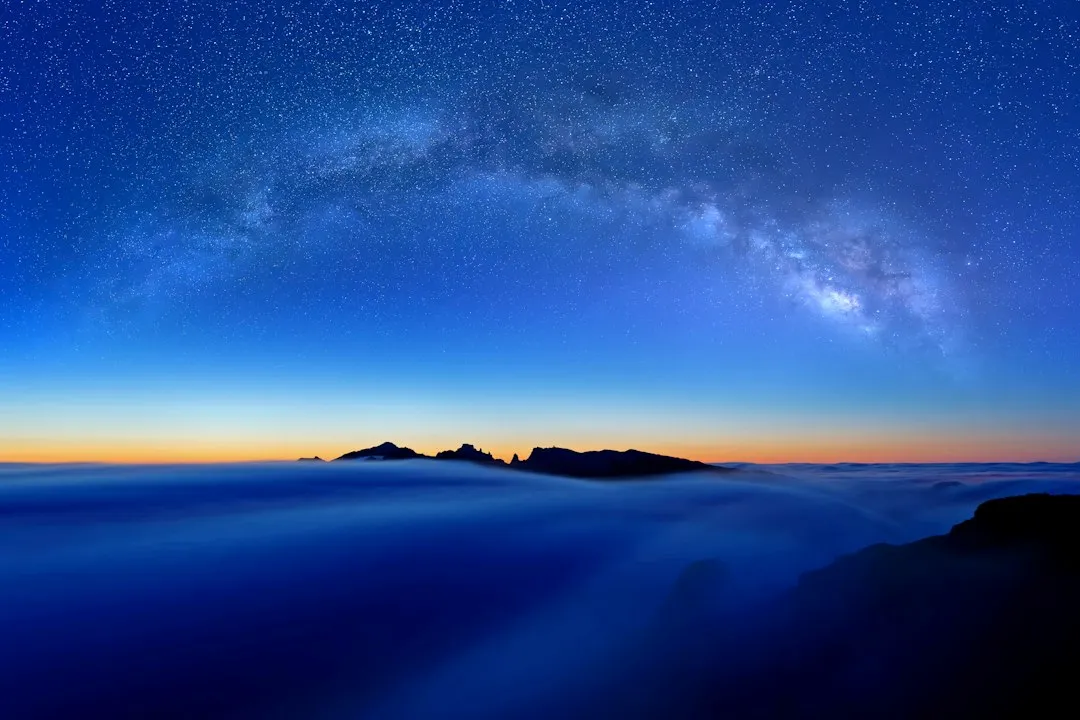
Photo by Colin Watts on Unsplash
Stargazing on Teide: Where to Go, When to Go and How to Do It Safely
Why the Teide sky is special
Teide National Park has been certified by the Starlight Foundation as both a Starlight Reserve and a Starlight Tourist Destination. The park floor lies at 2,000–2,300 m, above the layer of cloud that the trade winds pin against the island's slopes at roughly 1,000–1,500 m, so most nights in the caldera are clear while the coast is overcast. The air is dry and stable, and the Canary Islands have had a sky-protection law since 1988 that limits lighting and air traffic over the observatories. The Teide Observatory at Izaña, run by the Instituto de Astrofísica de Canarias at about 2,390 m, has hosted professional telescopes since the 1960s.
Where to watch
You need somewhere safe to park with no lights nearby. Three places work well:
- Mirador de las Minas de San José, on the TF-21 east of the cable car, is the viewpoint most tours use: large car parks on both sides of the road and open horizons.
- The Parador area and the Roques de García car park, opposite the hotel, give the classic Teide silhouette; the Parador itself runs regular observation sessions for its guests.
- The Montaña Blanca car park, at the start of trail 7 on the TF-21, is quieter and well placed for the summer Milky Way.
Stay in the car park or on the marked trail. The park's rules apply at night as during the day: no walking off the trails, no camping, no fires, no drones without a permit, and no driving onto the pumice.
When: season, moon and Milky Way
The moon decides everything. Plan the outing within four or five days of the new moon; a full moon washes out all but the brightest stars. Full darkness arrives about an hour and a half after sunset. The bright core of the Milky Way is a summer sight in the northern hemisphere: it rises before dawn in April, stands high in the evening from June to August and sets early by late September. Winter nights are longer and often more transparent, with Orion high. The Perseid meteor shower peaks around 12–13 August and the Geminids around 13–14 December. Saharan calima can spoil transparency for days at any time of year.
The cold is not a detail
At 2,100–2,300 m the temperature falls fast after sunset. Summer nights commonly sit between about 5 and 10 °C; from November to March readings below zero are normal and the car park can be icy. Dress as for a winter mountain walk: thermal layer, fleece, windproof jacket, hat, gloves, closed shoes and a blanket for sitting. A thermos of something hot and a red-light head torch complete the kit.
Driving up at night
Four roads enter the park: the TF-21 from La Orotava in the north and from Vilaflor in the south, the TF-24 along the ridge from La Esperanza and the TF-38 from Chío in the west. All are unlit and winding; allow 60–90 minutes from the coast and drive slower than by day. Fill the tank beforehand, because there is no fuel station in the park, and check the Cabildo's road information in winter: the access roads close when there is snow or ice. Never stop on the carriageway, and park with the lights off.
Guided tour or on your own
A guided session solves the three practical problems at once: transport, telescopes and someone who knows the sky. Typical formats combine sunset, a meal and an hour or two at telescopes, and last four to five hours. Going alone costs nothing beyond fuel, but the cold-weather kit, the night driving and the identification are on you; a star-chart app does most of the identification.
Visiting the Teide Observatory
The observatory is a working research site, not a visitor centre. Guided daytime visits run on set days by advance reservation through the official visits operator, last about an hour and a half, and include solar observation through dedicated telescopes and a look inside a night telescope. They are suspended from December to March because of the weather. There is no public access at night.
Photography basics
A tripod and a camera with manual settings are enough. Start at a wide focal length, aperture as open as it goes, ISO 1600–3200 and 15–25 seconds; focus manually on a bright star using live view and the magnifier.
Safety
- Stay on tracks and car parks: the ground is lava and loose pumice, and the slopes at Minas de San José drop away in the dark.
- Altitude is moderate here, but take it easy if you have come straight from the coast.
- Mobile coverage is patchy; tell someone where you are going. The emergency number is 112.
- Take everything back down with you.