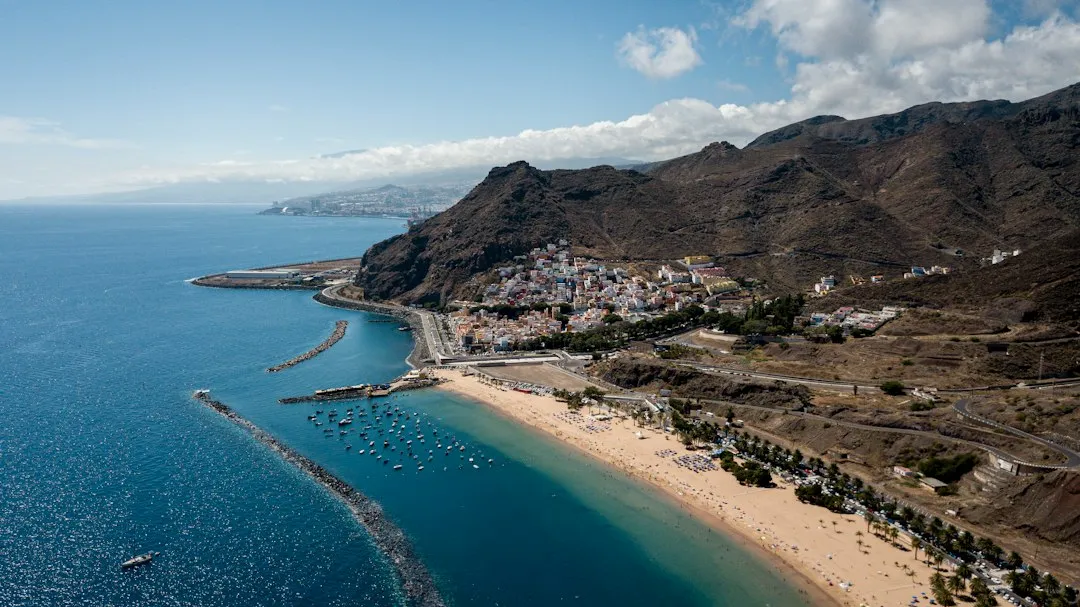
Photo by Maxim Berg on Unsplash
First Time in Tenerife: What to Know Before You Go
Two airports, two very different arrivals
Tenerife has two airports, about an hour apart by road. Tenerife Sur (TFS, Reina Sofía) sits in the municipality of Granadilla de Abona on the south coast and handles most international holiday flights from the UK, Germany and the rest of Europe. Tenerife Norte (TFN, Ciudad de La Laguna) is in San Cristóbal de La Laguna, around 11 km from Santa Cruz, and concentrates inter-island and mainland Spanish traffic, with a smaller share of international routes. If you are staying on the south coast, land at TFS; if your base is Santa Cruz, La Laguna or the Orotava valley, TFN saves you a long transfer. Bus line 343 links the two airports directly in about 50 minutes, so arriving at the wrong one is an inconvenience rather than a disaster.
North and south are different climates
The island is dominated by Teide, and the trade winds blowing from the north-east pile cloud up against the northern slopes. The result is a greener, cooler, more humid north, with a layer of cloud on many afternoons, and a drier, sunnier, warmer south in the lee of the mountain. The difference is a few degrees, not a different season, but it matters for a beach holiday. Choose the south if guaranteed sun is the priority; choose the north if you prefer lush scenery, historic towns and a more local atmosphere, and do not mind the odd grey afternoon.
Where to base yourself
Costa Adeje, Playa de las Américas and Los Cristianos form one continuous resort strip on the south-west coast. This is where most first-time visitors stay: large hotels, sandy beaches, short transfers from TFS and a wide choice of tours. Los Cristianos is the quietest of the three and has the ferry port.
Puerto de la Cruz is the traditional resort of the north: a real town with a botanical garden, a seafront promenade and natural sea pools, a short drive from La Orotava and the northern road up to Teide. It suits travellers who want character over nightlife.
Santa Cruz and La Laguna are the urban option. The capital has the port, the Auditorio and the best shopping; La Laguna, a UNESCO World Heritage city, has the colonial old town and the university. They are linked by tram and are the natural base for Anaga and for anyone who would rather eat and walk than sunbathe.
When to go
Tenerife works year-round. Winter is mild on the coast (roughly 18–22 °C by day) and is high season for northern Europeans; summer is hotter and busier with Spanish families. Carnival in Santa Cruz runs in February or March depending on the year, with parades and street parties that fill the capital's hotels. In summer, and occasionally at other times, a calima can arrive: hot, dusty air from the Sahara that hazes the sky and raises temperatures for a few days. The shoulder months (April to June, October to November) usually give the best balance of weather, prices and crowds.
Teide essentials
Pico del Teide is 3,718 m high, the highest point in Spain. The cable car takes you from 2,356 m to La Rambleta at 3,555 m in under eight minutes. Book a time slot online in advance; it sells out in high season and stops running in strong wind. Reaching the actual summit via the Telesforo Bravo trail requires a separate permit from the national park, booked through the Tenerife ON platform. Since January 2026 this permit is no longer free for non-residents: expect a fee in the region of €10–15 per person depending on the day, with limited places released in batches that go quickly. Book as early as you can, and bring warm layers, sunscreen and water: the altitude is real and the sun is intense.
Practical basics
- The currency is the euro. Cards are accepted almost everywhere, but carry some cash for small bars and rural spots.
- The language is Spanish. English and German are widely understood in the resorts, less so in the north and in the villages.
- Plugs are the European type F (two round pins), 230 V.
- Tap water is safe to drink but tastes of minerals; most residents and visitors buy bottled water.
- The sun is strong all year and far stronger at altitude. Factor 50 is the right choice on Teide and on boat trips.
- Outside the resorts, small towns still keep a long midday break: many shops close between roughly 14:00 and 17:00, and lunch is served late.
Do not miss
- The laurel forest and ridge roads of Anaga, in the north-east.
- The village of Masca and its road, one of the most dramatic drives on the island.
- A meal at a guachinche, the informal family-run eateries of the north that serve local wine and simple Canarian food.
- Teide at sunset, when the mountain's shadow stretches across the sea of clouds.